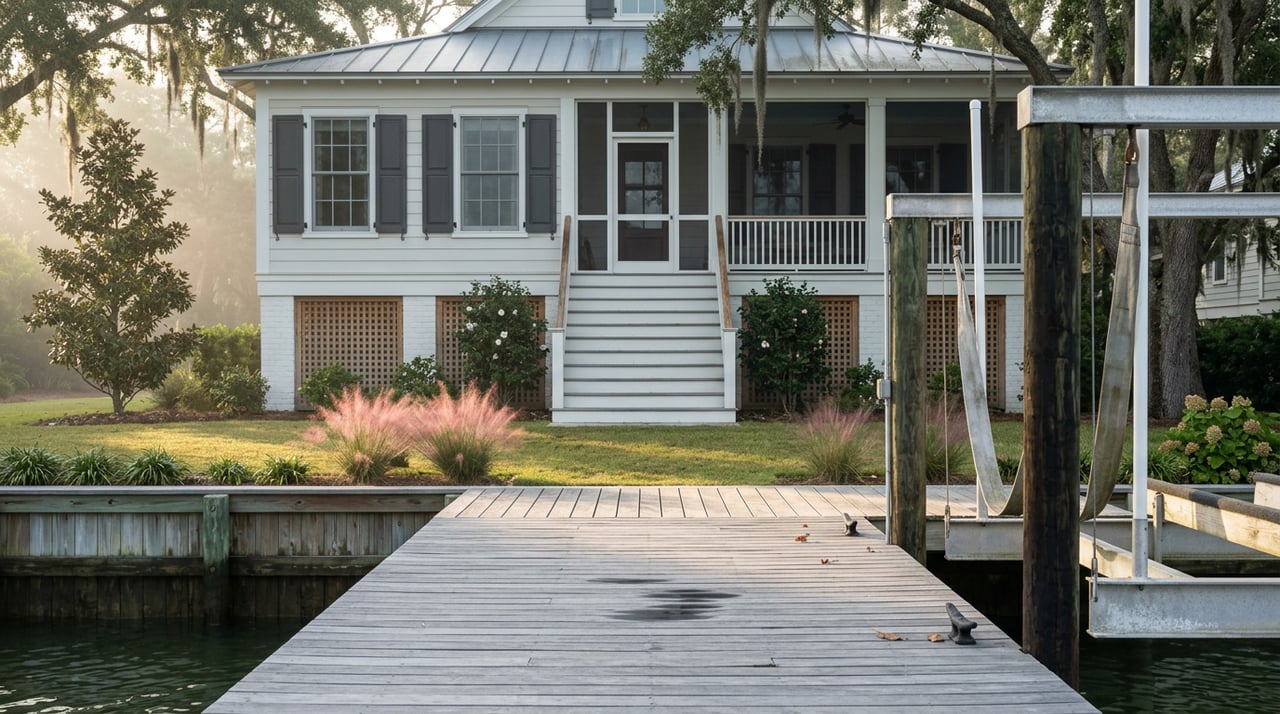
A buyer walks the dock behind a home on the Tchefuncte River, watches the current move past the pilings, and pictures a boat tied up by summer. What she does not picture is a stack of paperwork three agencies deep, because nobody mentioned it existed until her lender's title search came back with a question nobody could answer: who permitted this dock, and when.
That question, not the flood zone, is what actually slows down a waterfront closing in Madisonville.
The Water Isn't the Risk. The Dock Is.
Every waterfront guide tells you to check the flood zone. Fewer tell you that the structure sitting on the water, the dock, the bulkhead, the boathouse, is the part of the sale most likely to stall your closing. A house can be perfectly insurable and still come with a dock nobody can legally document.
That gap exists because Louisiana's riparian rights let a property owner build reasonably out to navigable water, but that right operates inside a permitting system, not instead of one. Owning the riverbank does not mean the structure on it was ever approved to exist. Docks get rebuilt after storms, bulkheads get patched piece by piece over a decade, and each of those repairs may have triggered a permit requirement that nobody filed for.
Three Signatures, Not One
Ask a Madisonville seller for the permit on their dock and you are really asking for three separate approvals. New construction, replacement, or what regulators consider a "substantial" repair to a dock, bulkhead, or shoreline stabilization project on the Tchefuncte typically needs sign-off from St. Tammany Parish, from Louisiana's coastal-use program, and from the U.S. Army Corps of Engineers for any work touching navigable water. Three agencies, three separate files, and no single office that keeps all three in one place.
That fragmentation is exactly why so many existing structures on the river are undocumented rather than illegal. Nobody set out to build without approval. A homeowner replaced a few rotted boards, an insurance claim paid for storm repairs, a previous owner added a boat lift, and none of it made it back to all three agencies. The parish's own Permits and Inspections office, based at 21454 Koop Drive in Mandeville, can tell you what is on file locally. It cannot tell you what the Corps or the state has on record, which means a clean parish file is not the same as a clean permit history.
Here is roughly how the requirement breaks down by structure type:
| Structure | Parish Permit | State Coastal Use | Army Corps of Engineers |
|---|---|---|---|
| New or replacement dock/pier | Typically required | Typically required | Required for work in navigable water |
| Bulkhead or seawall repair | Typically required | Typically required | Often, especially for substantial work |
| Dredging for boat access | Typically required | Typically required | Typically required |
| Boathouse or covered slip | Typically required | Typically required | Often |
The exact trigger point depends on scope and location, which is precisely the problem. A buyer cannot eyeball a dock and know whether the repair that built it crossed the threshold that required all three signatures.
The Insurance Number Everyone Quotes Is the Wrong One
Flood insurance is the part buyers do prepare for, and it is also the part they most often misjudge, because the number they anchor on is a parish-wide average that has almost nothing to do with a river-frontage purchase. As of August 2026, St. Tammany Parish carries roughly 49,055 active NFIP policies at an average annual premium near $1,192. That average blends every policy in the parish, from high-ground subdivisions in Covington to homes sitting directly on the Tchefuncte, and a river-adjacent property will not land anywhere near that midpoint.
What actually sets your premium is the elevation certificate, not the flood zone letter alone. Since FEMA's Risk Rating 2.0 model took effect, a home's first-floor height relative to Base Flood Elevation drives the price far more than which letter zone it sits in. Two houses on the same street can carry different premiums depending on how many feet of "freeboard" separate the living space from that elevation line. A raised home even one foot above BFE can see meaningfully lower premiums than a slab home in the same zone, which is why the certificate, not the zone map, is the document worth requesting before you get attached to a price.
It also helps to know what that risk actually looks like on paper. St. Tammany Parish has recorded 38,416 NFIP claims since 1978, totaling about $1.8 billion in payouts, an average claim near $46,000. That is not a reason to avoid the river. It is a reason to treat the elevation certificate as a financial document, not a formality, and to get one before you write an offer rather than after.
What To Request Before You Write the Offer
A waterfront offer in Madisonville should include a short, specific document request, not a general due-diligence clause.
- Ask for the elevation certificate and confirm it matches the current structure, not a prior configuration of the home.
- Ask for permits and as-built drawings for the dock, bulkhead, and any boathouse or covered slip, and note which of the three agencies each document covers.
- Confirm the flood zone designation directly against the current FEMA map rather than relying on what the listing states, since maps get updated.
- Ask whether the property is on parish water and sewer or a private well and septic system, since that changes both cost and inspection scope.
- If the seller cannot produce permits for the dock or bulkhead, treat any planned repair or replacement as a new permitting project, not a simple fix, and price that timeline into your closing expectations.
None of this requires an adversarial posture. It requires asking for paperwork before the inspection period closes rather than during it.
If the Permit Trail Gives You Pause: Renting the Slip Instead
Not every buyer needs to own the dock to enjoy the river. Madisonville has working marinas that make slip rental a real alternative to buying frontage outright, and for a buyer wary of an undocumented bulkhead, that alternative is worth pricing out before walking away from a house entirely.
Sawmill Docks Marina, tucked on Main Street near the historic site of the old Heisser Sawmill, offers short-term and transient slips within walking distance of downtown restaurants and the local hardware store, with published rates in the range of a dollar per foot daily or nine dollars per foot monthly as of this year. Marina Del Ray, a 121-acre facility on the Tchefuncte about a mile and a half from Lake Pontchartrain, added a new concrete "D" dock and an onsite restaurant, Reels Waterfront Bar and Grill, as part of a recent expansion, and remains the only marina below the Madisonville bridge.
Buying a home a few blocks off the water and renting a slip nearby sidesteps the entire permit question, along with the bulkhead maintenance and elevation-driven insurance swings that come with owning frontage. It is a genuinely different cost structure, and one worth running the numbers on before assuming waterfront ownership is the only way to keep a boat close.
Even navigating the river itself comes with layered local rules. St. Tammany Parish's own code caps boat speed at 45 miles per hour on the Tchefuncte between the Highway 22 bridge in Madisonville and the Interstate 12 bridge near Covington, and posts a separate Dead Slow, No Wake zone on the stretch closest to town near the Highway 22 bridge and Marina Del Ray's entrance, a detail that matters if a fast commute to open water is part of why you want the dock in the first place.
FAQ
Do I need a new permit just to repair an existing dock? It depends on scope. Minor maintenance often does not trigger a new filing, but what regulators consider a "substantial" repair, meaning work that goes beyond patching and starts to rebuild the structure, generally does. That threshold is exactly why so many older docks on the Tchefuncte have incomplete permit histories.
Is flood insurance required if I'm paying cash? No. Flood coverage is only mandatory when a property in a Special Flood Hazard Area is financed with a federally backed mortgage. Cash buyers can decline it, though given the claims history on this stretch of St. Tammany Parish, most local buyers choose not to.
What is riparian rights, and does it cover permitting? Louisiana's riparian rights allow a property owner reasonable use of adjacent water, including some ability to build out toward navigable channels. It establishes the right to have a dock, not permission to skip the parish, state, and federal approvals that structure still requires.
If you are weighing a property on the Tchefuncte and want a clear read on what its dock, bulkhead, or elevation certificate actually mean for your closing timeline, Allison Vencil can walk the permit trail with you before you write the offer, not after. Let's Connect.